A pay problem can sound similar in ordinary language while belonging to different processes. “I was not paid for work” may concern a wage obligation. “I was required to use one institution” raises a payment-choice question. “An unauthorized charge removed money from my card” concerns the account. Choosing a help route begins with the disputed event and the responsible body’s actual scope.
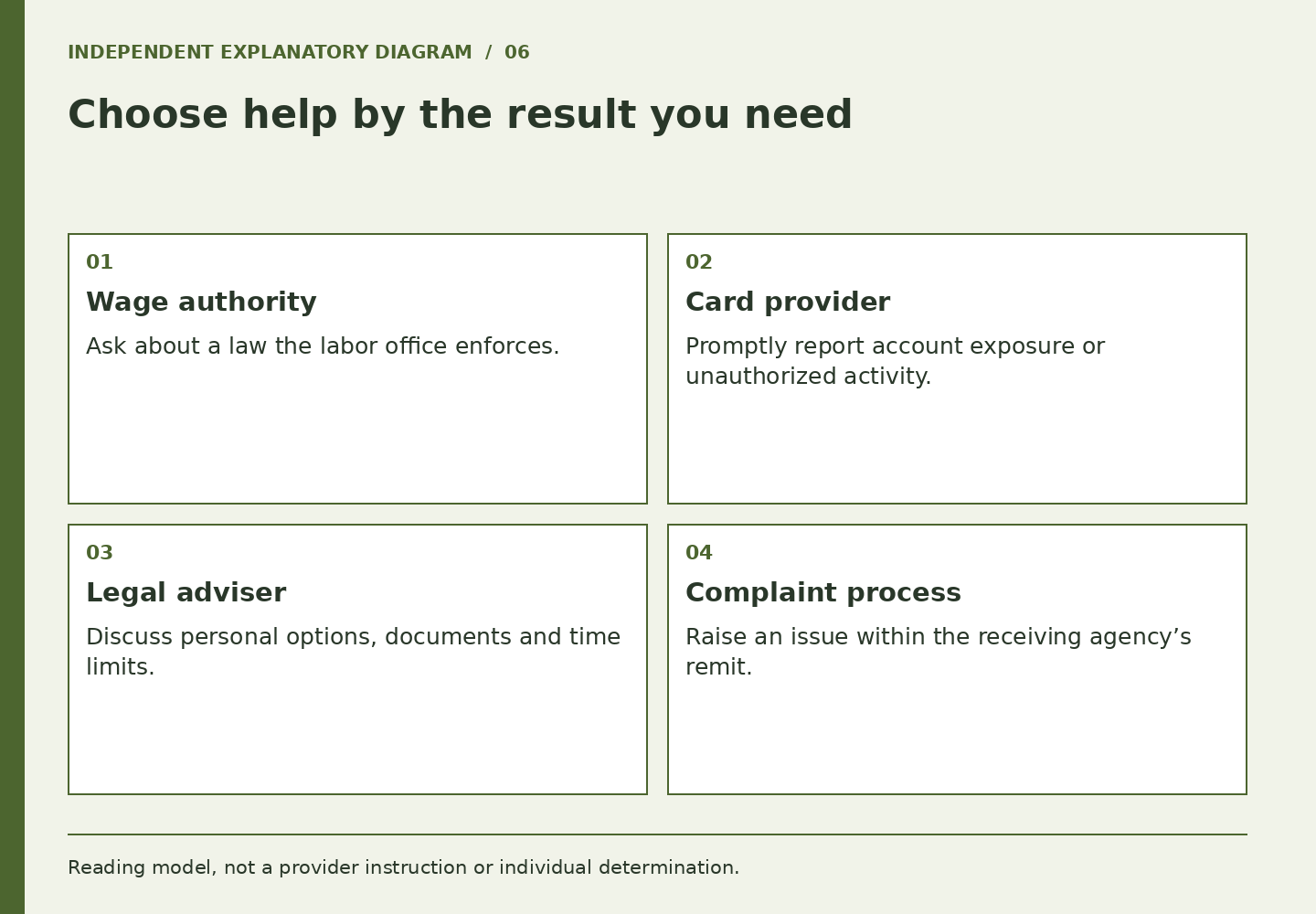
The U.S. Department of Labor’s Wage and Hour Division explains its complaint and investigation process for laws it enforces. The state labor-office directory can help locate state authorities. A directory entry or a federal agency’s existence is not a promise that it has jurisdiction over every wage-related issue.
Say what you need the recipient to explain
A good opening can be short: where the work occurred, the general employment situation, the period involved and the specific question. Ask whether the office handles that type of issue. You do not have to announce a legal theory first. You can say, “I am trying to understand which rule applies and whether your office handles this concern.”
In a fictional example, a worker asks a card provider whether the employer owes additional overtime. The provider may be able to describe account activity but cannot resolve every employment-law question. Another worker asks a labor office to reverse an unauthorized purchase. That office’s wage authority does not give it direct control over the card. Distinguishing the requests makes both conversations more useful.
Keep urgent account action separate
For lost cards, exposed PINs or unauthorized charges, contact the verified card provider promptly through its official process. Do not postpone that action while deciding whether to file an employment complaint. The CFPB complaint system includes prepaid-card issues, but a financial complaint is distinct from an immediate account-protection request and does not guarantee a recovery.
If the issue spans wage and account facts, explain the part relevant to each recipient. You may need more than one process, but avoid sending every private document to every office. Ask what information is needed and how to provide it securely. This publication’s editorial contact handles corrections to articles, not individual complaints or confidential case files.
Know when individualized advice matters
An agency can explain its remit and process; a qualified attorney or legal-aid organization may help evaluate personal options, documents and deadlines. Those roles can complement each other. Do not assume that a referral is a rejection on the merits, or that submitting a complaint creates an attorney-client relationship. Ask directly what assistance the recipient can provide.
If a deadline, overdue wage or retaliation concern is involved, make it visible early. Keep a concise record of the official response, next step and unresolved questions. Do not wait to use this site’s tool or to collect a perfect file before seeking timely help. Continue with time-limit questions and the legal-layer map. The aim is an appropriate authoritative conversation, not a guaranteed investigation, outcome or individual legal conclusion.
When a referral is given, confirm the receiving office’s scope and current contact information independently before sending private records.
Sources and reading boundaries
Sources checked October 7, 2026. This is a review date, not a policy effective date or an account test.
- U.S. DOL: How to File a Complaint: Complaint information and general investigation process. No promise to open, resolve, or recover a particular claim. Review basis: Official source text reviewed through search-index retrieval; direct navigation may be unavailable.
- U.S. DOL: State Labor Offices: Directory for finding the relevant state labor authority; a directory entry is not proof of jurisdiction or eligibility. Review basis: Official source text reviewed through search-index retrieval; direct navigation may be unavailable.
- CFPB: Submit a complaint: Current complaint scope includes prepaid cards; complaint routing is distinct from urgent account protection or a guaranteed remedy. Review basis: Official live page directly opened and reviewed.
- CFPB: Lost or stolen prepaid card, PIN or unauthorized charges: Prompt provider reporting; payroll cards have federal error-resolution protections. Particular liability, procedure and outcome are not determined here. Review basis: Official source text reviewed through search-index retrieval; direct navigation may be unavailable.
- U.S. DOL: Worker Complaint FAQs: Workers may seek information without already deciding to file; WHD has a defined federal remit and no fee for its complaint investigation services. Review basis: Official source text reviewed through search-index retrieval; direct navigation may be unavailable.