“You have to use this card” is a statement worth clarifying. The relevant issue is not whether a payroll card seems convenient, or whether coworkers like it. The issue is what choices the law requires and what the employer actually offers. That calls for a rule-specific question, with attention to state law and the precise payment arrangement.
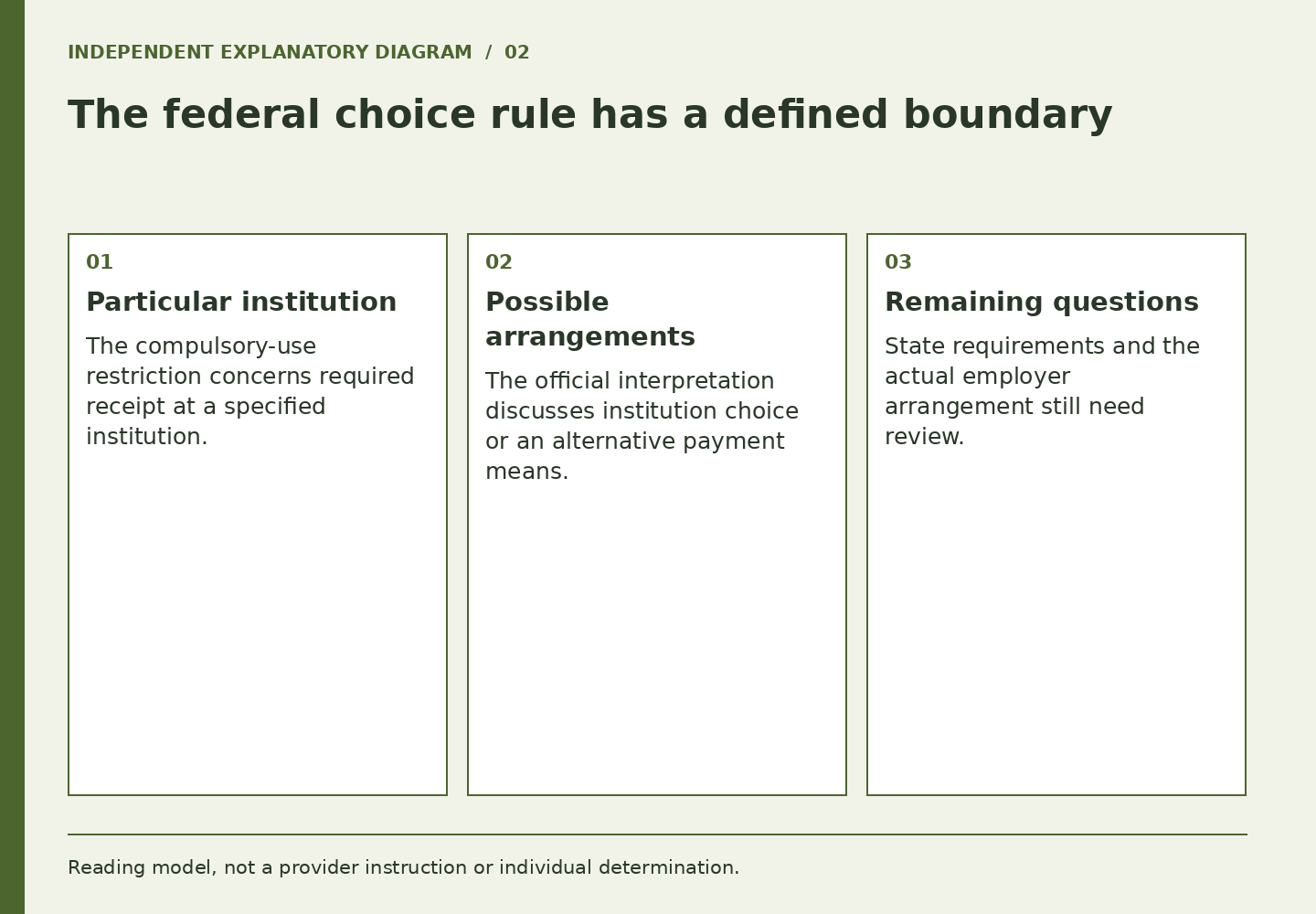
Regulation E section 1005.10(e)(2) restricts requiring an employee to receive wages by electronic transfer to a particular institution as a condition of employment. Its official payroll interpretation explains that an employer may require electronic direct deposit when employees may choose the receiving institution, or offer an employer-selected institution alongside another payment means. Applicable state law also matters.
Keep the claim narrower than the rule
That federal framework does not mean every employer must offer every imaginable method. It does not, by itself, promise a paper check to every worker. Nor does it resolve the details of a change request, the first payday after enrollment, or whether a particular form meets a state’s requirements. Avoid converting “a specific institution cannot be compulsory in this way” into a broader statement that the source does not support.
This distinction matters because an overly broad claim can distract from a valid concern. You do not need to demand a method the rule does not establish in order to ask why one institution appears mandatory. The strongest initial question describes the actual instruction and asks which alternatives are available under the applicable requirements.
Ask for the real policy, not a hypothetical menu
An original inquiry could say: “I was told this payroll card is the only available wage-delivery method. What alternatives are available for employees working in this state, and where is the current policy?” This is a request for information, not a waiver of rights or an instruction to close an account. Use the employer’s genuine payroll or human-resources route.
In a fictional example, an orientation handout lists only one card, but payroll explains that employees can designate another institution. The incomplete handout and the actual policy are different facts. In another example, payroll confirms that no alternative exists. That answer gives a worker a more specific issue to discuss with the relevant agency or qualified adviser. Neither fictional outcome determines the legality of a real workplace.
Separate choice from account protection
A disagreement over wage-delivery choice does not mean you should abandon access to wages already issued or stop monitoring an existing account. Account closure, changes to direct-deposit instructions and employment disputes can have different consequences. Ask the responsible parties about the actual change process without assuming this article authorizes or recommends a particular account action.
Keep a copy of the employer’s instruction or your own accurate note of the conversation if you can do so lawfully. Do not record conversations secretly based on this guide; recording rules vary. If pressure, nonpayment or retaliation is involved, seek timely authoritative guidance instead of waiting for a polished packet. Continue with retaliation questions or agency scope. This is general legal education, not a decision about your employer or a substitute for current state-specific advice.
Sources and reading boundaries
Sources checked October 7, 2026. This is a review date, not a policy effective date or an account test.
- Regulation E, section 1005.10: Compulsory-use restriction in subsection (e)(2); does not guarantee a paper check or every payment method. Review basis: Official current regulation directly opened and reviewed.
- Regulation E: Official interpretation of section 1005.10: Payroll interpretation explains choosing the receiving institution or another payment method; state law remains relevant. Review basis: Official source text reviewed through search-index retrieval; direct navigation may be unavailable.
- U.S. DOL: State Labor Offices: Directory for finding the relevant state labor authority; a directory entry is not proof of jurisdiction or eligibility. Review basis: Official source text reviewed through search-index retrieval; direct navigation may be unavailable.