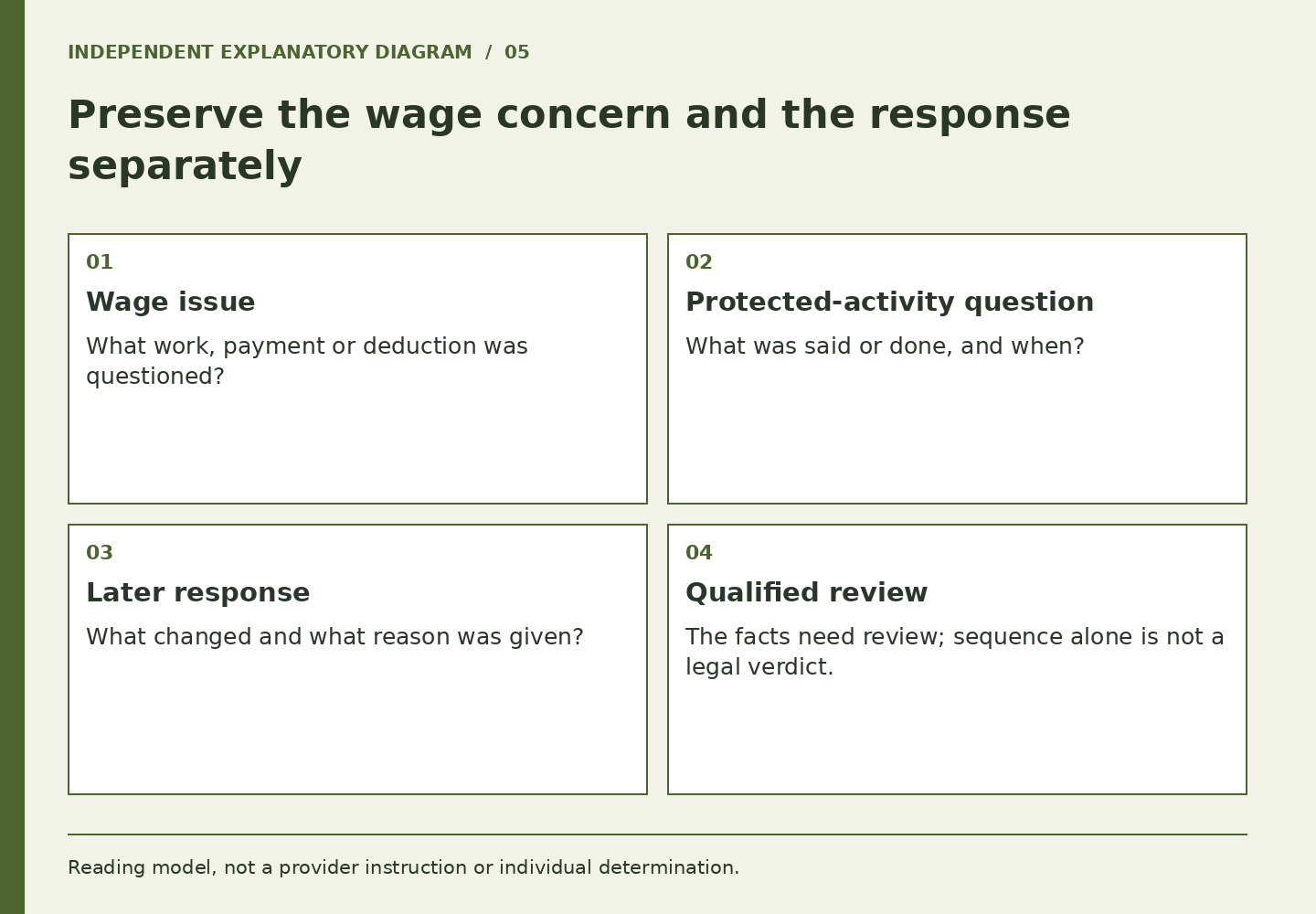
A wage question and the response to raising it can become two separate concerns. A worker might first ask about unpaid time, then experience a schedule change, a threat or a dismissal. Even when the original pay calculation remains unresolved, the later conduct deserves its own factual description. Do not assume that you must first win the wage dispute before asking about retaliation protections.
DOL Fact Sheet 77A describes the FLSA’s prohibition on retaliation for protected complaints and cooperation with investigations. The scope of protected activity, proof and available remedies requires careful analysis. This article cannot decide that a particular action was retaliatory, and timing alone should not be presented as a complete legal finding.
Preserve two timelines
The first timeline concerns the underlying wage issue: what work or payment was disputed and when you raised it. The second concerns the response: what changed, when it changed and what explanation was given. Keep exact words distinct from your interpretation. If you are recalling a conversation rather than quoting a saved message, label it as a recollection.
In an original fictional example, a worker asks about a uniform deduction and later loses a scheduled shift. The sequence is important, but the article cannot infer motive from those two facts alone. A useful account identifies the wage question, the schedule change, any stated reason and relevant records. It avoids both dismissing the concern and announcing a verdict before review.
Seek advice without creating new exposure
A worker may reasonably worry about how to ask for help. Use a verified agency or qualified adviser and ask about the process and its privacy limits before sending unnecessary detail. Do not rely on this publication for an absolute anonymity promise. An agency’s confidentiality practices and the practical possibility that an employer may infer who raised an issue are different matters.
Do not secretly record conversations based on this article, access restricted workplace systems or contact coworkers in ways that expose their private information. You can keep lawful records already available and write an accurate personal account. If you are uncertain how to preserve a particular item, ask a suitable adviser instead of assuming a wage concern overrides other restrictions.
Make the urgency visible
If the situation involves threats, loss of income, an upcoming deadline or safety concerns, say that clearly when seeking help. Do not wait until the employer completes an internal review to ask about external rights and time limits. At the same time, this guide does not advise quitting, confronting a manager or taking another consequential employment action. Those decisions deserve context-specific support.
If an agency says one law does not cover the concern, ask whether another authority or qualified resource may be relevant. Different protections can have different scope. Continue with questions about timing and accurate notes without a perfect file. The useful next step is a timely, factual inquiry about the response you experienced, while preserving the separate question about the wages themselves.
Keep the employer’s explanation alongside the sequence rather than replacing it with your inference.
Sources and reading boundaries
Sources checked October 7, 2026. This is a review date, not a policy effective date or an account test.
- U.S. DOL: Fact Sheet 77A, Prohibiting Retaliation: FLSA anti-retaliation protection for complaints and cooperation; individual coverage, proof and remedies need qualified review. Review basis: Official source text reviewed through search-index retrieval; direct navigation may be unavailable.
- U.S. DOL: Worker Complaint FAQs: Workers may seek information without already deciding to file; WHD has a defined federal remit and no fee for its complaint investigation services. Review basis: Official source text reviewed through search-index retrieval; direct navigation may be unavailable.