A payroll card is a way money reaches a worker. It does not identify every rule governing how much the worker earned, when wages were due, or what an employer may deduct. A question that begins with a Fintwist balance may therefore involve more than the card account. Understanding the legal layers helps you ask a useful question without assuming that a familiar product name supplies the answer.
The provider’s public site identifies Fintwist as Corpay Prepaid and distinguishes payroll from other disbursement products. This publication concentrates on workers’ general wage-rights questions. It does not determine whether any particular payment is wages, whether a worker is covered by a law, or whether an employer or financial institution violated it.
Start with the obligation you are asking about
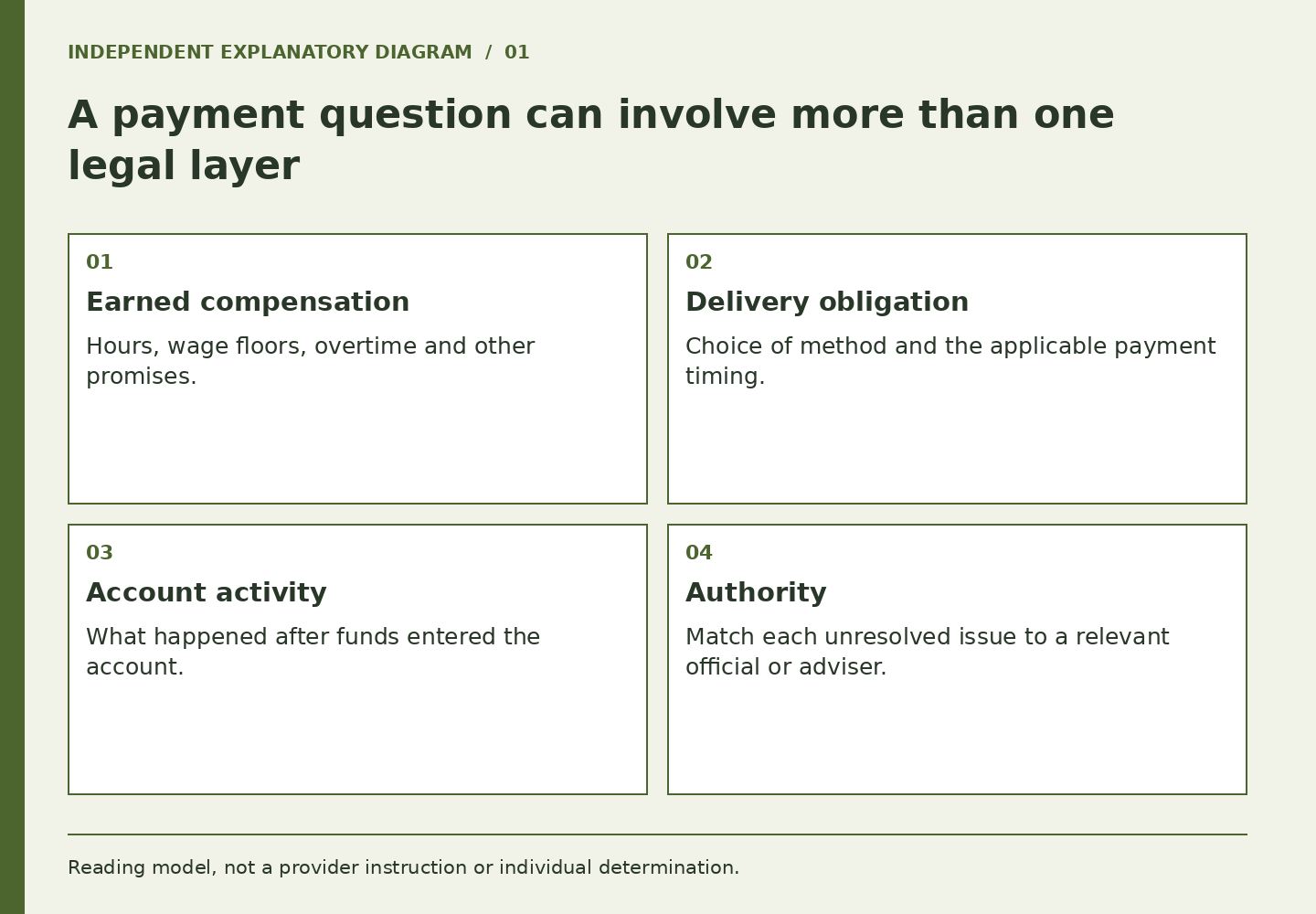
Use three plain-language questions. What compensation was required for the work? What rules govern the way and timing it is paid? What happened within the account after a transfer? These questions may be connected, but their legal sources can differ. A cardholder agreement is not a complete statement of employment law. A wage statute is not a transaction history.
The Fair Labor Standards Act framework described by DOL addresses federal minimum wage, overtime and related protections for covered work. State and sometimes local rules can add relevant protections. Separately, federal consumer-finance rules address payroll-card use. An employment agreement or collective bargaining agreement may raise another question. Identify these as possible layers, not automatic conclusions about a particular reader.
Write a question that preserves the distinction
In an original fictional example, a worker says, “My final pay went to a card, so the card company decides whether vacation must be paid.” The better question is: “Which employment rule or agreement determines whether this payment is owed, and which organization can explain how an issued payment was delivered?” The second version keeps the entitlement question from being lost inside an account inquiry.
A different worker may have received the stated wages but believes they were required to accept a particular card. That raises a choice question even without a missing deposit. Yet another may question hours omitted from pay. The same account product can appear in all three stories while the facts needed for review remain different.
Build a small jurisdiction note
For your own preparation, note where you performed the work, the dates involved, the employer’s identity and the general type of work. If work crossed state lines or was remote, flag that complication rather than choosing a state solely from the employer’s headquarters. A relevant agency or qualified adviser can explain which law and forum apply. The DOL state-office directory is a starting point, not a jurisdiction decision.
Keep unknowns visible. You can ask an agency about coverage before assembling a perfect legal theory. Do not wait for this publication’s worksheet if pay is overdue, a notice contains a deadline, or retaliation is a concern. Continue with the payroll-card choice rule, wage floors and promised pay, or the agency-scope guide. The goal is a clearer request for authoritative help, not a self-issued legal verdict.
Sources and reading boundaries
Sources checked October 7, 2026. This is a review date, not a policy effective date or an account test.
- Corpay Prepaid: public home page: Current Fintwist to Corpay Prepaid naming and PayCard/FlexCard distinction only. No generalization of issuer, fees, feature eligibility, or individual terms. Review basis: Official live page directly opened and reviewed.
- U.S. DOL: Wages and the FLSA: Covered nonexempt workers, federal minimum-wage/overtime framework; not an individualized coverage determination. Review basis: Official source text reviewed through search-index retrieval; direct navigation may be unavailable.
- U.S. DOL: State Labor Offices: Directory for finding the relevant state labor authority; a directory entry is not proof of jurisdiction or eligibility. Review basis: Official source text reviewed through search-index retrieval; direct navigation may be unavailable.