Leaving a job can create several payment questions at once: the last wages, unused leave, commissions, reimbursements, deductions and access to records. These items do not necessarily follow one rule. A payroll-card account may continue to exist after employment ends, but that does not answer when an employer must pay a particular amount or whether an additional amount is owed.
The DOL final-pay overview says federal law does not generally require an immediate final paycheck, while some states may require earlier payment. That statement is not a universal permission to delay pay until a chosen date. State law, the type of separation and other facts can matter. This guide supplies questions, not a deadline calculation.
Put dates in separate places
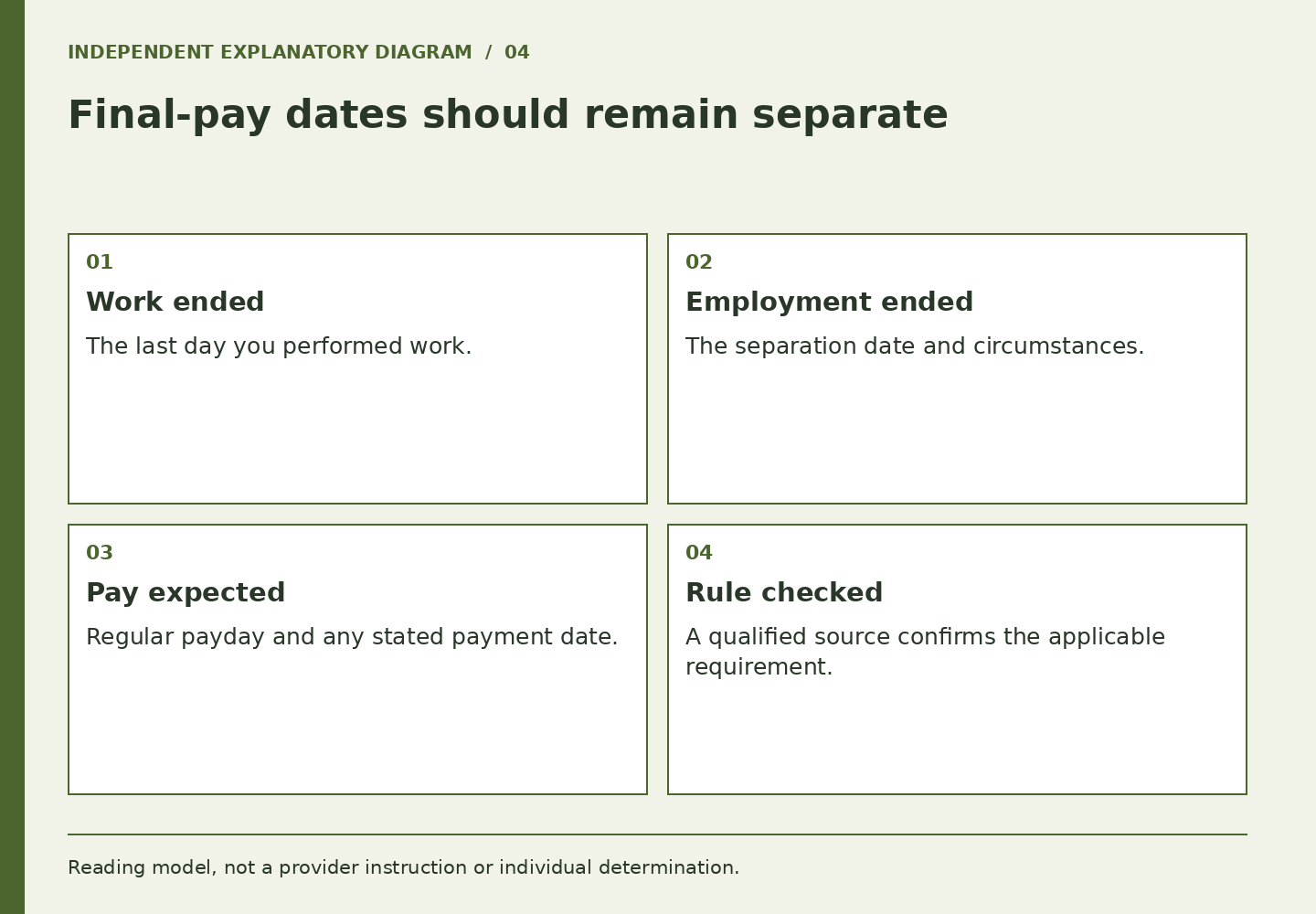
Note the last day work was performed, the date employment ended if different, the regular payday and any date given in a separation notice. If you resigned, were discharged, or have an unclear employment status, describe that accurately. Avoid making the dates identical merely because you expect one final payment. A reviewer may need to distinguish them.
In an original fictional example, a worker leaves midway through a pay period and receives a message promising payment on the next normal cycle. That promise is one fact. The applicable final-pay rule is another. The worker can ask the relevant state labor authority whether the promised timing fits the situation instead of assuming the employer’s usual calendar settles it.
Break the expected payment into items
List the categories you are asking about without assuming they are all owed: wages for work performed, possible overtime, a disputed deduction, a promised commission, unused leave or reimbursement. Ask which rule or agreement governs each unresolved item. A general federal minimum-wage source may not answer a leave-payout question, and a cardholder agreement will not establish the employer’s commission obligation.
If an amount has been issued, distinguish evidence of issuance from access to the funds. If a payment is missing, ask what the employer says was paid and what remains outstanding. Avoid sending complete account histories to every person involved. Use the relevant official process for private records, and keep the inquiry focused on the specific unresolved obligation.
Do not wait for a complete exit packet
You can seek help before every document is available. If wages appear overdue, contact the appropriate labor authority or a qualified adviser promptly and explain the information you have. Ask about deadlines and next steps directly. Do not assume that an employer’s promise to review the issue later extends any legal time limit.
Before signing a release, settlement or acknowledgment whose consequences you do not understand, seek qualified advice. This publication cannot interpret that document for your circumstances. If access to workplace records is ending, retain only material you may lawfully keep; do not access systems after authorization ends. Continue with working with incomplete records and questions about timing. The useful outcome is a current, jurisdiction-specific answer about the actual item, rather than a nationwide promise this publication cannot support.
Sources and reading boundaries
Sources checked October 7, 2026. This is a review date, not a policy effective date or an account test.
- U.S. DOL: Last Paycheck: Federal law does not generally require an immediate final paycheck; states may require earlier payment. No individual due date calculated. Review basis: Official source text reviewed through search-index retrieval; direct navigation may be unavailable.
- U.S. DOL: State Labor Offices: Directory for finding the relevant state labor authority; a directory entry is not proof of jurisdiction or eligibility. Review basis: Official source text reviewed through search-index retrieval; direct navigation may be unavailable.
- U.S. DOL: Back Pay: FLSA recovery mechanisms and limitations vary with circumstances; guide deliberately does not calculate a filing deadline. Review basis: Official source text reviewed through search-index retrieval; direct navigation may be unavailable.